We are at the cusp of what the Bank of Canada calls the “Fourth Industrial Revolution,” which involves more technological innovation and creative destruction. Although there seem to be more job functions becoming obsolete due to automation, the fact is that we are still seeing more jobs created than being destroyed because of the impact of digital technologies to the future of work (Poloz, 2018). One particular sector that has demonstrated a large growth over the past 11 years is the gig economy (Langton, 2019).
The article by the Bloomberg News Network exhibits the rise of the gig economy in the millennial population of Canada. According to the article, over 40% of Canada’s millennial population has participated in the gig economy (McNeil, 2019). Graph 1.1 shows the growth of this employment trend, while table 1.1 displays the most common types of “gig” works.
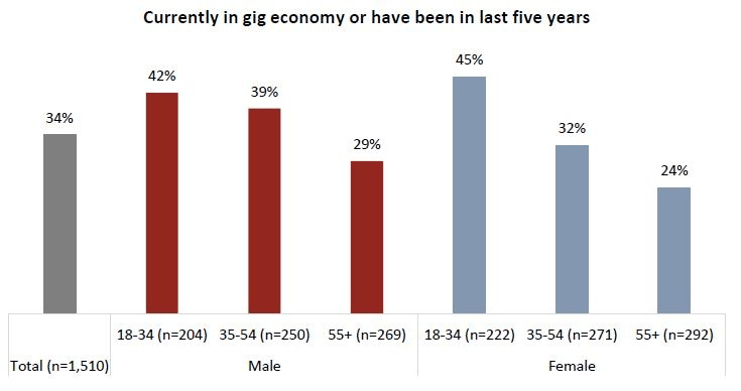
Source: McNeil, 2019: https://www.bnnbloomberg.ca/40-of-canada-s-millennials-are-part-of-the-gig-economy-study-1.1353301
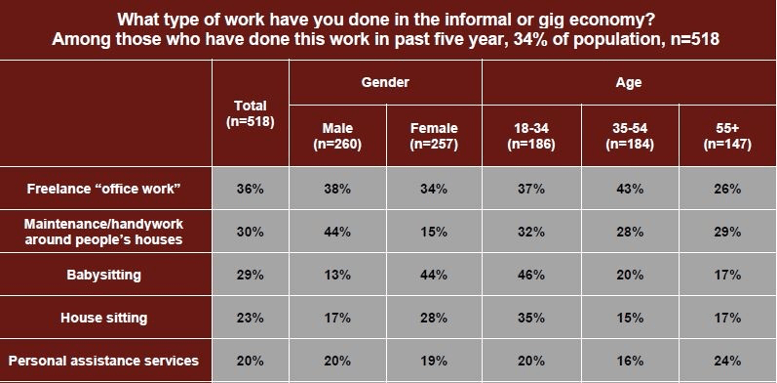
Source: McNeil, 2019: https://www.bnnbloomberg.ca/40-of-canada-s-millennials-are-part-of-the-gig-economy-study-1.1353301
While exact reasons may vary, over 30% of all respondents declared that they cannot fully sustain their needs and therefore, take on these precarious, and uncertain types of work along with their day-jobs. Additionally, 13% find it difficult to find full-time jobs (McNeil, 2019). These companies are the most common platforms to have gig opportunities:

Canadians are still uncertain if it is totally a good or a bad trend (McNeil, 2019). The main issue at hand is that the rise of the gig economy somehow suggests that there are more millennials who are working without a safety net such as employment insurance or benefits (Johal & Thirgood, 2016). The people who participate in the gig-economy are the most vulnerable to loss of welfare due to its self-employment nature. This causes more inequities in the labour industry, which is also a major issue in and of itself. As the millennial population continues to engage in this form of work, their futures are increasingly put under financial uncertainties. While there are numerous concerns around the gig-economy, I am focusing on the two main causes of vulnerability:
- Lack of Bargaining Power
- Lack of Benefits
To accommodate this growing trend, Active Labour Market Policies (ALMPs) must be restructured in a way that would take into account the workers within this sector.
The independent nature of the gig economy threatens the overall participation of millennials to labour unions, resulting in the inability to negotiate with employers. Furthermore, the lack of bargaining power creates an uneven power dynamic between the employers and the workers. This evidently shows the need for better information dissemination of workers’ rights and how to navigate this kind of work. A potential solution is adopting a labour union specifically for food delivery app workers. This is an initiative that started in Japan and Norway to combat the vulnerability of their gig workers within this industry (Gurley, 2019). This will enable workers to collectively protest their rights and ensure companies’ compliance with labour policies.
Another factor that needs consideration is the lack of benefits surrounding the gig economy. This reinforces major inequities as workers will face more disadvantages from the lack of support. Additionally, the lack of benefits will contribute to the long list of challenges that women face in the workplace as, according to Statistics Canada, women are more likely to take on gig work than men (Sung-Hee, Liu & Ostrovsky, 2019). A potential solution for this issue is providing a portable plan to provide welfare support until gig workers find a more stable and full-time job (Lee, 2019). However, this solution needs thorough analysis of how much contributions would be justifiable. Workers within the gig economy, oftentimes, are in lower-income brackets (Sung-Hee, Liu & Ostrovsky, 2019).
This development of new ALMPs would require compliance and collaboration between employers and employees. However, these digital platforms have particularly crafted their business model to avoid an enormous amount of labour costs through piecework. As such, a state intervention would be needed.
The gig economy is already a result of an increasingly competitive labour market combined with some jobs becoming obsolete because of technology. With the rate of how the digital world is shaping the current labour market, policymakers need to act at an equal or even faster rate than the rapid technological innovation we experience today.
References:
Gurley, L. (2019). Gig Workers Are Forming the World’s First Food Delivery App Unions. Vice US. Retrieved on March 08, 2020 from https://www.vice.com/en_ca/article/59nk8d/gig-workers-are-forming-the-worlds-first-food-delivery-app-unions
Sung-Hee, J., Liu H., & Ostrovsky, Y. (2019). Measuring the Gig Economy in Canada Using Administrative Data. Statistics Canada: Catalogue no. 11F0019M — No. 437. ISBN 978-0-660-33525-4
Langton, J. (2019). Gig workers on the rise: StatsCan. Advisor’s Egde. Retrieved on March 08, 2020 from https://www.advisor.ca/news/economic/gig-workers-on-the-rise-statscan/
Poloz, S. (2018). Today’s Labour Market and the Future of Work. Chancellor David Dodge Lecture in Public Finance 2018. Retrieved on March 08, 2020 from https://www.bankofcanada.ca/2018/03/todays-labour-market-future-work/
McNeil, S. (2019). 40% of Canada’s millennials are part of ‘the gig economy’: Study. BNN Bloomberg. Retrieved on March 08, 2020 from https://www.bnnbloomberg.ca/40-of-canada-s-millennials-are-part-of-the-gig-economy-study-1.1353301
Lee, J. (2019). Canada’s growing gig workforce highlights need for portable benefits plan: report. Benefits Canada. Retrieved on March 08, 2020 from https://www.benefitscanada.com/news/canadas-growing-gig-workforce-highlights-need-for-portable-benefits-plan-report-124674.
Johal,S. & Thirgood, J. (2016). Working Without a Net: Rethinking Canada’s social policy in the new age of work. Mowat Centre, University of Toronto: School of Public Policy and Governance.

 Christian Soriano's EMPR 240 Blog
Thank you, Christian, for a very well written post. I like the way you described the general phenomenon, Identified, expatiated on particular problems within the phenomenon and explored possible solutions to address these problems.
I believe that the gig economy is a reflection of the complexity of today’s society. It not only represents changes in opportunities created by new technologies but also, changes in our production, manufacturing and service processes. While a lot of emphases are placed on the industries that propagate gig culture, I believe better understanding will be gleaned by researching the nature of workers who participate in this economic sector. Do they prefer gig work over regular work? Are there constrained to this kind of work because of other personal circumstances such as family, health, school or do they gravitate to these jobs due to lack of other opportunities?
Either way, I agree with you that the gig economy exposes employees to live without a safety net. In 2018, following a review into modern working practices by Matthew Taylor, a former aide to ex-PM Tony Blair and chief executive of the Royal Society of Arts, the UK government implemented policies design to, among other things,
• close a loophole that had allowed agency staff to be paid less than permanent employees
• ensure firms provide a “statement of rights” on the first day of a person’s employment, setting out what paid leave they are entitled to, including for illness, maternity and paternity leave
• increase the maximum fine employers face at a tribunal from £5,000 to £20,000, if they are found to have demonstrated “malice, spite or gross oversight”
• ensure that companies calculate holiday pay based on 52 weeks, as opposed to 12 weeks, so people in “seasonal or atypical roles get the paid time off they are entitled to”
I wonder if there are similar policies in Canada.
LikeLike
Hi Daniel,
Thanks for your comment. I appreciate your praises and I enjoy reading more about inputs and opinions about the current phenomenon. I agree that the gig economy was not only brought forward by technology but also by the rapid globalization and massive changes in the supply chain. I do think that deeper research must be done to completely understand the predicament that a lot of the millennials face today.
In the general scheme of things, the main reason why millennials take on gig work is the fact that they may not be earning enough to sustain their lifestyle. As I mentioned in my blog, some people take on gig work alongside their day jobs to earn extra income. I don’t think that they prefer gig work over regular, but gig work acts as a supplement and for others with a little more technical skills, it might be a way for them to develop their skills even further.
Nonetheless, gig work varies and it could be from delivery services to web development. This shows that gig work does not only cater to the unskilled labourers but also to technical people as well. It also shows that the rise of the gig economy can be attributed to the lack of opportunity and the insufficient salary to sustain the increasing standard of living. In your own opinion, what other factors do you think affect the trend towards the gig economy?
As far as I know, Canada does not have a policy as intricate as the policy you raised. I believe there has been a wave of protests and conversations to increase the awareness of the rise of the gig economy.
Thank you so much for your comment and feel free to ask for some more clarification.
– Christian S.
LikeLike