The Gig Economy: Contributing or Diminishing Workers’ Welfare?

We are at the cusp of what the Bank of Canada calls the “Fourth Industrial Revolution,” which involves more technological innovation and creative destruction. Although there seem to be more job functions becoming obsolete due to automation, the fact is that we are still seeing more jobs created than being destroyed because of the impact of digital technologies to the future of work (Poloz, 2018). One particular sector that has demonstrated a large growth over the past 11 years is the gig economy (Langton, 2019).

The article by the Bloomberg News Network exhibits the rise of the gig economy in the millennial population of Canada. According to the article, over 40% of Canada’s millennial population has participated in the gig economy (McNeil, 2019). Graph 1.1 shows the growth of this employment trend, while table 1.1 displays the most common types of “gig” works.
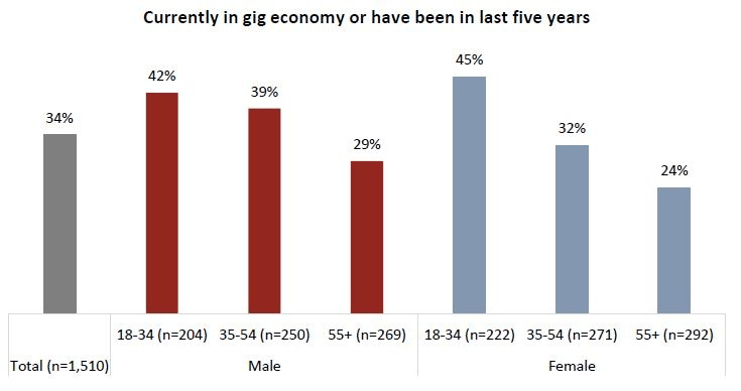
Graph 1.1
Source: McNeil, 2019: https://www.bnnbloomberg.ca/40-of-canada-s-millennials-are-part-of-the-gig-economy-study-1.1353301
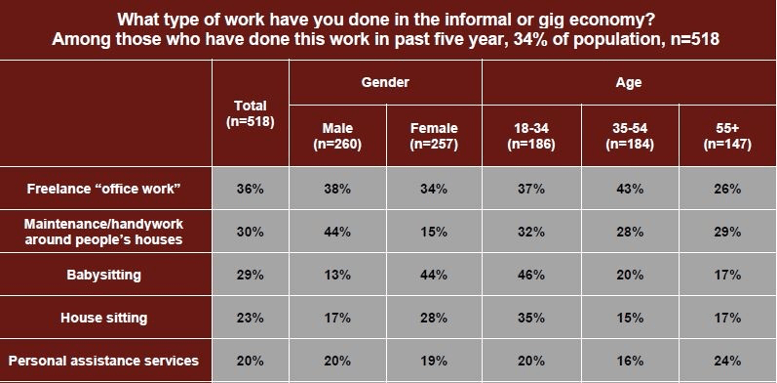
Table 1.1
Source: McNeil, 2019: https://www.bnnbloomberg.ca/40-of-canada-s-millennials-are-part-of-the-gig-economy-study-1.1353301

While exact reasons may vary, over 30% of all respondents declared that they cannot fully sustain their needs and therefore, take on these precarious, and uncertain types of work along with their day-jobs. Additionally, 13% find it difficult to find full-time jobs (McNeil, 2019). These companies are the most common platforms to have gig opportunities:

Canadians are still uncertain if it is totally a good or a bad trend (McNeil, 2019). The main issue at hand is that the rise of the gig economy somehow suggests that there are more millennials who are working without a safety net such as employment insurance or benefits (Johal & Thirgood, 2016). The people who participate in the gig-economy are the most vulnerable to loss of welfare due to its self-employment nature. This causes more inequities in the labour industry, which is also a major issue in and of itself. As the millennial population continues to engage in this form of work, their futures are increasingly put under financial uncertainties. While there are numerous concerns around the gig-economy, I am focusing on the two main causes of vulnerability:

  1. Lack of Bargaining Power
  2. Lack of Benefits

To accommodate this growing trend, Active Labour Market Policies (ALMPs) must be restructured in a way that would take into account the workers within this sector.

The independent nature of the gig economy threatens the overall participation of millennials to labour unions, resulting in the inability to negotiate with employers. Furthermore, the lack of bargaining power creates an uneven power dynamic between the employers and the workers. This evidently shows the need for better information dissemination of workers’ rights and how to navigate this kind of work. A potential solution is adopting a labour union specifically for food delivery app workers. This is an initiative that started in Japan and Norway to combat the vulnerability of their gig workers within this industry (Gurley, 2019). This will enable workers to collectively protest their rights and ensure companies’ compliance with labour policies.

Another factor that needs consideration is the lack of benefits surrounding the gig economy. This reinforces major inequities as workers will face more disadvantages from the lack of support. Additionally, the lack of benefits will contribute to the long list of challenges that women face in the workplace as, according to Statistics Canada, women are more likely to take on gig work than men (Sung-Hee, Liu & Ostrovsky, 2019). A potential solution for this issue is providing a portable plan to provide welfare support until gig workers find a more stable and full-time job (Lee, 2019). However, this solution needs thorough analysis of how much contributions would be justifiable. Workers within the gig economy, oftentimes, are in lower-income brackets (Sung-Hee, Liu & Ostrovsky, 2019).

This development of new ALMPs would require compliance and collaboration between employers and employees. However, these digital platforms have particularly crafted their business model to avoid an enormous amount of labour costs through piecework. As such, a state intervention would be needed.

The gig economy is already a result of an increasingly competitive labour market combined with some jobs becoming obsolete because of technology. With the rate of how the digital world is shaping the current labour market, policymakers need to act at an equal or even faster rate than the rapid technological innovation we experience today.

References:

Gurley, L. (2019). Gig Workers Are Forming the World’s First Food Delivery App Unions. Vice US. Retrieved on March 08, 2020 from https://www.vice.com/en_ca/article/59nk8d/gig-workers-are-forming-the-worlds-first-food-delivery-app-unions

Sung-Hee, J., Liu H., & Ostrovsky, Y. (2019). Measuring the Gig Economy in Canada Using Administrative Data. Statistics Canada: Catalogue no. 11F0019M — No. 437. ISBN 978-0-660-33525-4

Langton, J. (2019). Gig workers on the rise: StatsCan. Advisor’s Egde. Retrieved on March 08, 2020 from https://www.advisor.ca/news/economic/gig-workers-on-the-rise-statscan/

Poloz, S. (2018). Today’s Labour Market and the Future of Work. Chancellor David Dodge Lecture in Public Finance 2018. Retrieved on March 08, 2020 from https://www.bankofcanada.ca/2018/03/todays-labour-market-future-work/

McNeil, S. (2019). 40% of Canada’s millennials are part of ‘the gig economy’: Study. BNN Bloomberg. Retrieved on March 08, 2020 from https://www.bnnbloomberg.ca/40-of-canada-s-millennials-are-part-of-the-gig-economy-study-1.1353301

Lee, J. (2019). Canada’s growing gig workforce highlights need for portable benefits plan: report. Benefits Canada. Retrieved on March 08, 2020 from https://www.benefitscanada.com/news/canadas-growing-gig-workforce-highlights-need-for-portable-benefits-plan-report-124674.

Johal,S. & Thirgood, J. (2016). Working Without a Net: Rethinking Canada’s social policy in the new age of work. Mowat Centre, University of Toronto: School of Public Policy and Governance.

Social Media Conduct – Grounds for Work Dismissal? (EMPR 240 Weblog 1)

Quick Link to the article: https://www.ctvnews.ca/canada/employee-who-got-6-bbq-sauce-as-holiday-gift-says-he-was-fired-for-angry-tweet-1.4752283

With the world becoming more digital every day, it is not a surprise that employers are now using social media platforms to keep their employees in check. LinkedIn alone, the largest professional social media network, has over 575 million users since its inception in 2002 (Osman, 2020). With that, who is to say employers are not watching their employees with other platforms? The concept of using social media activities as a way to track off-site employee actions is a hotly debated topic today in the workplace policy involving both employees and employers. The main concern brought forward by the former is that it seems to be an invasion of privacy while the latter is concerned with the effects of employee’s social media activities with the overall company’s image. In addition, the provision of severance pay is also an issue being raised. In this particular blog, I will argue that the dismissal due to social media conduct is valid given that three main criteria are to be followed: communication, process, and policies

The primary issue of the article is whether or not the dismissal of Mr. Mehaidli was legal? According to the issue, Mr. Mehaidli’s employer, Fastenal, gave Canadian employees barbeque sauce as a holiday gift. He, then, posted on his social media raising his disappointment with the management. He was dismissed on the grounds of violating “standards of conduct policy – acceptable conduct section” (Slaughter, 2020).

This is one of the many cases of improper social media activities resulting in termination of employment. There are multiple things to consider when determining whether this form of dismissal is legal and just. This type of termination is valid as long as the company’s standard social media conduct policies were communicated clearly, and employees were given proper training and information. In addition, the implications of such a violation should also be transparently communicated. Clarifications can also help in defining what can be deemed as proper social media conduct.

Secondly, employees should be entitled to a due process. One difference between US and Canada employment law is the concept of “at-will” employment. This means that employers are entitled to dismiss a worker at will but a legal justification in Canada is required (Rousse, 2012). This may, perhaps, be the reason why Fastenal, a US-based company terminated Mr. Mehaidli’s employment on the spot. As well, an employee should be given notice when his/her employment is about to get terminated.

Finally, dismissing a worker should also follow standard policies regarding post-dismissal This involves providing a severance package for terminated employees with multiple factors considered including the number of years with the company. According to McCarthy Tétrault, a Canadian law firm, since there is no “at-will” employment policy implemented in Canada, employers need to provide constructive dismissal which can be in the form of a costly severance package (Rousse, 2012).

Judging the case at hand would be difficult without analyzing the other side of the story. This dismissal case, however, can be seen as a petty business decision from the company and can potentially result in a negative public relation. Although employees are not entitled to receive gift bags and goodies, those barbeque sauce gifts certainly diminished workers’ morale. Finally, having served over six years with the company, I believe Mr. Mehaidli is entitled to receive a more constructive post-dismissal which will include a severance package and an ample time to find another employer.

References:

Osman,M. (2020). Mind-Blowing LinkedIn Statistics and Facts (2020). Kinsta. Retrieved on February 05, 2020 from https://kinsta.com/blog/linkedin-statistics/

Rousse, J. (2015). Five Key Differences Between Canadian and U.S. Employment Law. McCarthy Tetrault. Retrieved on on February 05, 2020 from https://www.mccarthy.ca/en/insights/articles/five-key-differences-between-canadian-and-us-employment-law

Slaughter, G. (2020). Employee who got $6 BBQ sauce as holiday gift says he was fired for angry tweet. CTV News. Retrieved on February 05, 2020 from https://www.ctvnews.ca/canada/employee-who-got-6-bbq-sauce-as-holiday-gift-says-he-was-fired-for-angry-tweet-1.4752283


Let Me Introduce Myself

Hi Everyone! Welcome to my blog! My name is Christian Soriano and I am currently a third-year student taking Applied Economics with a Business and Entrepreneurship Certificate. My friends refer to me as Christian, however my Starbucks name is Chris. I don’t have any preferences really! I am extremely involved within the innovation community and mainly focus on social enterprises and EdTech. You will probably always see me around Mitchell Hall at the Innovation Space as I love being involved and actively engaged in tech and entrepreneurship organizations at Queen’s. During my spare time, I like to go to different local coffee shops and get a taste of their ice coffee. In addition to that, I love to try exotic food as well. So far, I have tried snails, frog legs, crickets, grilled chicken blood cubes, octopus, and more!

I started working when I was 18 and my first job was at a Shoe Store called “Little Burgundy.” My main functions revolved around sales and floor management. I would often work with different customers and make sure that they have the best retail experience as they step through our doors. Working there was a transformative experience. I got to learn more about business functions and how conflicts would sometimes come about within organizations. Every day was a learning experience from communications to finance. I would say that I owe my confidence and eloquence to my first job. Not only was I able to experience working with a team of diverse individuals, I also learned how to communicate value and how to continuously improve your skills.

I want to learn more about the Health, Safety and Injury aspect of Labour Policy. I want to get a grasp of what the current trends are for claims, compensation and compliance of companies. There are hundreds of thousands of claims every year, and there is definitely common patterns for these claims which can question the proactivity of companies to respond to these workplace claims. I also want to know how these claims are being compensated and how effectively can you quantify injuries at work which can go beyond medical coverage. Finally, with the rapid digitalization and technological changes in the workplace, companies seem to cut corners and put their workers safety at risk. I want to learn more about current policies that contribute in mitigating these instances and protect the welfare for the labour force while making sure companies stay honest and comply to these policies.